Best Stainless Steel Fermenters for Home Brewing
Choosing the right stainless steel fermenter is essential for consistent, high-quality home-brewed beer, wine, mead, or kombucha. This guide highlights five top stainless steel fermenters that balance durability, ease of cleaning, and sensible features like conical bottoms, integrated valves, and reliable sealing. All options are made from food-grade stainless steel and designed to minimize sediment buildup and contamination risk. Whether you’re upgrading an old setup or starting a new brewing station, these fermenters represent strong all-around performance with practical accessories and thoughtful design.
Summary of selected products:
| Product | Capacity | Key Feature | |
|---|---|---|---|
| VEVOR Fermentation Tank 8 Gallon | 8 Gallons | Conical base, 0.5mm thick 304 stainless steel | VEVOR |
| Anvil Stainless Steel Bucket Fermenter | 7.5 Gallons | Coned bottom, rotating racking arm | Anvil |
| VEVOR Fermentation Tank 16 Gal | 16 Gallons | Large capacity, conical bottom, yeast and beer valves | VEVOR |
| VEVOR Pressure Fermenter 15 PSI | 16 Gallons | Pressure design, cooling coil, real-time monitoring | VEVOR |
| Chapman UniVessel 14 Gallon | 14 Gallons | Ready-to-use, easy to clean, batch-friendly | Chapman UniVessel |
VEVOR Fermentation Tank 8 Gallon

Designed for home brewers, the VEVOR 8-gallon fermentation tank uses thick 0.5mm food-grade 304 stainless steel for the barrel, handles, inner lining, clasps, and lid. The device is built to resist deformation and simplify cleaning due to its smooth, non-porous surface. The lid’s embedded silicone seal provides double-layered protection against leakage, while a high-elasticity clasp maintains a tight seal that helps keep pests out and prevents spills during transport or agitation. An optional exhaust port enables sterile, breathable fermentation by releasing surplus gases.
Anvil Stainless Steel Bucket Fermenter – 7.5 gallon

This 7.5-gallon Anvil fermenter emphasizes a coned bottom to promote efficient sediment collection and easy clarification. The unit includes a rotating racking arm to simplify transferring beer or wine without disturbing the sediment. Made from 304 stainless steel, it offers solid durability and straightforward cleaning, making it a practical choice for hobbyists who value reliable gravity-flow operations and straightforward maintenance during multiple fermentation cycles.
VEVOR Fermentation Tank 16 Gal

The 16-gallon VEVOR tank provides a generous capacity for larger batches with a wide mouth for easier loading and cleaning. Its conical bottom supports sediment settling, while included yeast slurry and beer valves simplify discharge and bottling. The vessel uses 304 stainless steel for body, handles, lid, and lining, delivering durability and resistance to staining. The lid seal is reinforced with silicone, and the clasp design helps prevent leaks and insect intrusion, even when the fermenter is moved or rotated during use.
VEVOR Pressure Fermenter 15 PSI
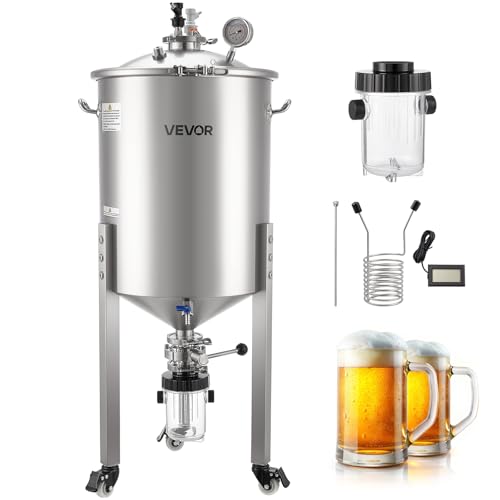
This all-in-one 16-gallon pressure fermenter combines secondary fermentation with precise temperature control. Its pressure design helps prevent CO2 overflow and allows real-time monitoring of fermentation pressure. A built-in cooling coil connects to a chiller for accurate wort temperature management, while the 0.5 mm thick 304 stainless steel body provides sturdy, food-grade construction. The brews benefit from a controlled environment, particularly when working with higher-gravity fermentations or extended aging processes.
Chapman UniVessel 14 Gallon
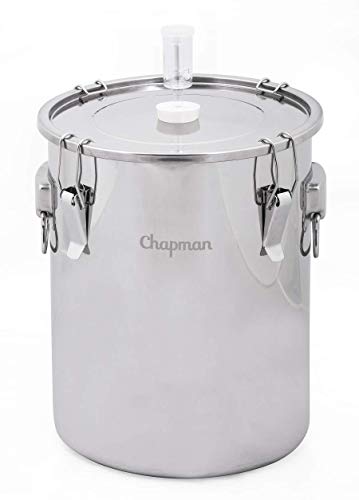
The Chapman UniVessel offers a ready-to-use configuration optimized for 10-gallon batches with ample headroom. It emphasizes ease of cleaning and straightforward operation, making it suitable for brewers who prefer a simpler setup without compromising basic features like durable stainless steel construction and reliable sealing. Its design supports a range of fermentation styles, from beer to mead, and accommodates batch processing with minimal setup time.
Stainless Steel 7 Gal Fermenter with Ball Valve

While not among the five main picks, this 7-gallon Chapman UniVessel model with a 3-piece ball valve supports convenient drainage and monitoring. It is a practical option for smaller 5-gallon batches and features easy cleaning, sturdy construction, and precise valve integration for better transfer accuracy and sanitation during the fermentation and bottling phases.
Ai-C-Dibosh 60L Stainless Steel Fermentation Barrel

This 60-liter barrel emphasizes heavy-duty stainless steel with 1.0 mm (wall) and 1.2 mm (bottom) thickness, offering robust durability for larger-scale fermentation. It uses 304/316 stainless steel as a food-grade material and includes components such as a temperature patch, silicone plug, one-way valve, and silicone ring. While larger in capacity, its premium build supports long-term use for serious hobbyists and small-scale producers seeking a high-capacity option.
Buying Guide: Key Purchase Considerations and Comparisons
Capacity and batch size: Choose a fermenter that accommodates your typical brew volume. For repeatable 5–10 gallon batches, 7–14 gallon models are common and practical. Larger batches (15–16 gallons) suit serious hobbyists or small-batch production, but ensure your space and gear (airlock, temperature control) can keep up.
Conical bottom and valves: A conical base aids sediment collection and yeast management, while integrated valves (ball valves, yeast/discharge valves) simplify transfers and bottling. A well-sealed lid with a silicone gasket helps prevent leaks and contamination, and some models offer a cooling coil or pressure feature for advanced fermentation control.
Material and build quality: Look for 304 (or higher) stainless steel with reasonable thickness to resist dents and corrosion. A smooth interior surface reduces residue buildup and eases cleaning. Consider if the neck opening is wide enough for easy loading and cleaning, and whether the unit is designed to withstand regular disassembly for sanitation.
Sealing, vents, and safety: Some fermenters offer exhaust ports to manage gases during fermentation or pressure-safe features to reduce the risk of CO2 buildup. If you work with high-gravity worts or long fermentation times, a unit with reliable sealing and optional aeration control can improve consistency.
Temperature control compatibility: Fermenters with built-in cooling coils or compatibility with external chillers enable precise temperature management. Temperature stability is critical for flavor development and avoiding off-flavors due to heat spikes or rapid fermentation shifts.
Cleaning and maintenance: Favor designs with smooth welds, rounded corners, and accessible interior surfaces. Detachable components like lids, seals, and valves should be easy to sanitize. Consider how easily you can wipe down or scrub sediment from any conical areas.
Price and value: While premium features add convenience, the best value comes from a unit that meets your batch size needs with durable construction and reliable fittings. Weigh long-term durability against upfront cost to determine total cost of ownership.
Leave a Reply