Best Food pH Meter for Testing: Top Picks for Fermentation, Canning, and Sourdough
Answering the need for accurate, kitchen-friendly pH testing, these picks are ideal for home cooks, hobby fermenters, and small-batch canners. Each product below is best for specific use cases—whether you’re sourdough baking, canning salsa, or monitoring fermentation. Read on to find which meter matches your process, along with practical buying guidance.
| Product | Brand | Best For | Notes |
|---|---|---|---|
| EZTOCH Food pH Meter | EZTOCH | Multi-use fermentation, canning, and yogurt/sauce batches | Bluetooth tracking adds convenience |
| YINMIK Food pH Meter Digital | YINMIK | Sourdough and broad fermentation tasks | Includes spear probe for semi-solids |
| GIDIGI pH Meter for Food Fermentation | GIDIGI | Sourdough, meats, and sauces with spear probe | ATC with temperature display |
| GIDIGI Food pH Meter with ATC | GIDIGI | Fermentation and canning projects requiring stable readings | Extended features and sturdy build |
| UIUZMAR Smart pH Meter | UIUZMAR | Real-time monitoring via app for liquids and solids | Digital storage and real-time checks |
EZTOCH Food pH Meter for Canning and Fermentation
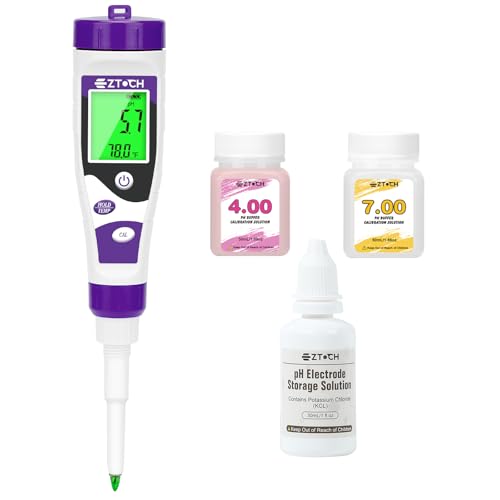
Best for versatile kitchen testing, the EZTOCH pH meter is designed to cover canning, fermentation, and baking needs. It helps determine high-acid foods suitable for water-bath canning (pH below 4.6) and low-acid items for pressure canning (pH above 4.6). It also notes usefulness for sourdough management and home brewing. The Bluetooth capability supports recording pH trends over time, which can be valuable for ongoing recipe accuracy.
Who should consider this: home canners and bakers who want a single meter that spans multiple tasks, from tomato sauces and hot sauces to sourdough starter management. Why selected: its broad scope aligns with common home fermentation and canning workflows.
Caution: Bluetooth features may require pairing setup and a compatible device for data logging; function may vary by firmware.
YINMIK Food pH Meter Digital pH Tester with Spear Probe

Best for sourdough fermentation and broader food tests, this meter uses a spear probe to penetrate semi-solid foods like dough, sausages, and sauces. It offers a 0.00-14.00 pH range with ±0.1 accuracy, suitable for precise fermentation control and recipes where pH matters for texture and safety. It’s also positioned as useful for cosmetic testing, which broadens its utility for hobbyists.
Who should consider this: bakers and charcuterie enthusiasts who measure pH in doughs and firm foods. Why selected: the spear design makes measurements faster and more representative in dense textures. Caution: spear probes can be less convenient for very liquid samples, potentially requiring sample prep to avoid drift.
GIDIGI pH Meter for Food Fermentation with Spear Probe

Best for precise fermentation work, this GIDIGI model emphasizes high accuracy (±0.01 pH) with automatic temperature compensation. The spear tip probe is designed to handle semi-solid samples, making it suitable for dough, meat, and cheese mixtures. It supports 32-140°F (0-60°C) testing and includes calibration options to maintain accuracy over time.
Who should consider this: serious home fermenters and cooks who want lab-like precision in a kitchen tool. Why selected: the combination of ATC, spear probe, and a backlit display reduces reading errors and supports varied ambient temperatures. Caution: calibration solutions are required for best accuracy; ensure you have them on hand.
GIDIGI Food pH Meter with ATC for Sourdough & Meat

Best for repeatable, stable readings in fermentation and canning projects, this meter provides ATC and a spear probe for both liquids and semi-solids. It is designed to help maintain pH accuracy across fluctuating kitchen temperatures and includes calibration options to simplify setup. The product is positioned as beginner-friendly yet capable for more demanding fermentation tasks.
Who should consider this: anyone who wants reliable, easy-to-use measurements with a robust calibration process. Why selected: ATC contributes to consistent results across varying environments. Caution: ensure you understand the calibration steps to avoid drift when first setting up.
GIDIGI Smart pH Tester Strips for Food

Best for on-the-go testing and quick checks, this is a professional-grade tester designed for food acidity in canning and cooking contexts. It features a 0.01 pH resolution and an integrated temperature reading. The app-connected feature supports data storage and notes, enabling traceability across batches.
Who should consider this: users who want rapid, smartphone-connected readings and the convenience of mobile data storage. Why selected: Smart features help track pH trends over time. Caution: strips-based meters can be less precise than spear probes for thick or very complex samples; use the right tool for the texture you’re testing.
Buying Guide: What to Consider When Choosing a Food pH Meter
pH meters for food testing come in a range of styles. Consider accuracy, probe type, temperature compensation, calibration needs, and data handling when selecting a model for your kitchen or small studio. Below are practical questions and guidance to help match a meter to your workflow.
- What sample types will you test? If you work mostly with semi-solid foods (dough, cheese, sauces), prioritize a spear probe. For liquids like soups, brines, and beverages, a standard probe can suffice.
- How important is temperature compensation? Automatic temperature compensation (ATC) helps reduce reading drift in warm or cool environments. Choose ATC if your kitchen temperature fluctuates.
- Do you need app integration or data logging? Meters with Bluetooth or app support are helpful for tracking pH trends over time across batches.
- What calibration resources are included? Look for a meter that ships with calibration solutions (commonly 4.00 or 7.00 pH) to simplify setup and ongoing accuracy.
- Is a backlit display important? A backlit screen improves readability in dim or busy kitchens, especially when testing small volumes or darker foods.
- How easy is calibration and maintenance? Calibrations should be straightforward, with replaceable probes or kits available if you test often.
Practical comparisons by use-case
- Sourdough and fermentation: Prefer meters with spear probes, ATC, and easy calibration, such as the GIDIGI and YINMIK options.
- Canning and jarred sauces: Choose models designed for food safety checks with robust calibration and reliable readings, like EZTOCH and GIDIGI variants.
- Mobile or on-the-go testing: Consider smart meters with app storage and real-time data access, such as the UIUZMAR model.
FAQ
- Q: What pH range is best for fermentation monitoring?
- A: A typical safe fermentation pH range is around 3.0 to 6.0, depending on the product. Use a meter with at least a 0.01 pH resolution for precise control.
- Q: Do I need separate meters for canning and sourdough?
- A: Not necessarily. A multi-use meter with spear probe capability and ATC can cover both tasks, but separate meters can offer specialized convenience for one task.
- Q: How often should I calibrate the meter?
- A: Calibrate regularly, especially after extended storage or temperature changes. Follow the included calibration solutions and guidelines for best results.
- Q: Can I use pH meters for cosmetic testing?
- A: Some meters can measure cosmetics; however, ensure the device materials and sanitation practices align with cosmetic testing requirements.
- Q: What is ATC, and why does it matter?
- A: Automatic Temperature Compensation reduces measurement error by adjusting readings for ambient temperature, which improves accuracy for diverse kitchen conditions.
Leave a Reply