Best Home Brewing Grain Mills for Efficient Beer Mash
Answer: You want a durable, adjustable grain mill that fits your brewing setup and volume. The best home brewing grain mills below cover manual and drill-enabled options, large hoppers, and precise roller gaps to maximize extract efficiency. They’re ideal for homebrewers aiming to crush malt, barley, and grain consistently while preserving husks for sparging. The top picks balance capacity, ease of use, and build quality for small to medium batch brewing.
| Product | Hopper Capacity | Grinding Method | Best For |
|---|---|---|---|
| VEVOR Manual Grain Mill | 1.06 gal | Manual with 2 rollers | Moderate batches, manual operation |
| FERRODAY Malted Grain Mill (2 Roller) | 7.7 lb | Manual with drill-ready | Large batches, drill-assisted power |
| Brewland Grain Mill Brewing | 7.7 lb | Manual or drill | Flexible for big batches |
| FERRODAY Malted Grain Mill (2 Roller) | 7.7 lb | Manual with drill-ready | Consistent crush, large batches |
| GQWQNIO 4L Roller Adjustable | 4 L | Manual or electric drill | Fine control, versatile power options |
VEVOR Manual Grain Mill for Home Brewing
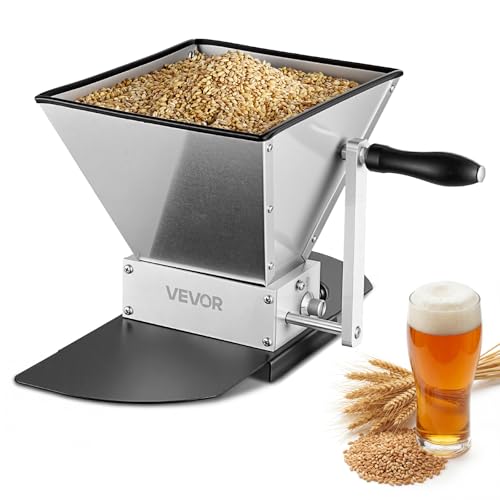
The VEVOR model uses two stainless steel rollers with an 8-level adjustable gap (0.025″–0.1″), enabling precise control over grind size. A 1.06-gallon aluminum hopper supports longer grinding runs between fills. This mill is designed for home brewing, crushing malt, barley, and grain while keeping the hull intact for sparging. It is best for brewers who want a reliable manual option with straightforward adjustments and a compact footprint.
Best for: medium-sized batches and brewers who prefer manual operation without a drill. Limitations: not recommended for corn or flake grinds. Choose this if you want a sturdy, simple mill with adjustable gaps and a respectable hopper size.
FERRODAY Malted Grain Mill, 2 Roller Stainless Steel

This Ferroday 2-roller mill features a large 7.7-pound hopper and 5-inch rollers with 12 TPI knurl to efficiently pull grains through while preserving hull integrity. The gap is adjustable from 0.025″ to 0.1″, enabling a fine or coarse crush. A notable feature is the drill mode, where a low-speed drill can drive the mill for high throughput—up to 7 pounds per minute in drill mode. This model is ideal for brewers scaling up or seeking faster mash efficiency.
Best for: large-batch brewers who want both manual and drill-assisted milling. Limitation: not suitable for corn, soybeans, or flake flour. Choose this if you plan high-volume mashes and want optional power-assisted operation.
Brewland Grain Mill Brewing with 7.7LB Hopper
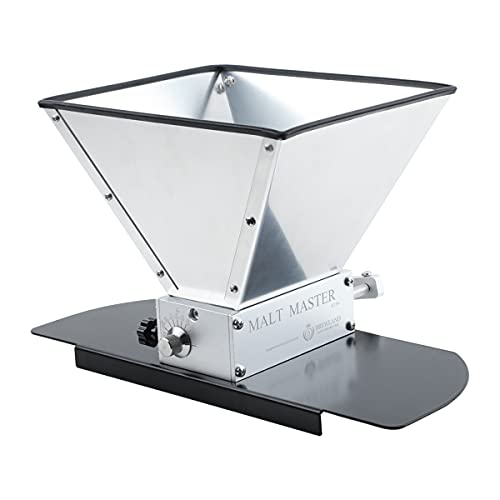
Brewland’s grain mill is designed specifically for homebrewing, featuring an 8-calibration knob to adjust the roller spacing from 0.025″ to 0.1″. It is suitable for malted barley and malted wheat, with a large 7.7-pound hopper. It offers two grinding modes: manual crank or power-assisted via a low-speed drill with an 8mm hex socket. This flexibility makes it well-suited for brewers who want consistent crush and faster throughput on bigger batches.
Best for: brewers who value dual grinding modes and a sizable hopper. Limitation: not for corn, coffee beans, or sugarcane. Choose this if you want a versatile option that can scale with batch size and power source.
FERRODAY Malted Grain Mill, 2 Roller Stainless Steel

This Ferroday variant emphasizes a large 7.7-pound hopper and 2-roller stainless steel construction for durable, food-grade operation. The mill offers a 0.025″–0.1″ adjustable gap and supports drill-mode for faster throughput. The design emphasizes rust resistance and long-term use, with a focus on malted grains such as barley and wheat. This option suits brewers who want both manual control and optional powered milling to maximize mash efficiency.
Best for: large-batch brewers who appreciate precise control and durability. Limitation: not designed for corn or large amounts of non-malt grains. Choose this if you prioritize a robust build and consistent malt crush.
GQWQNIO 4L Manual Grain Mill with Adjustable Roller Gap
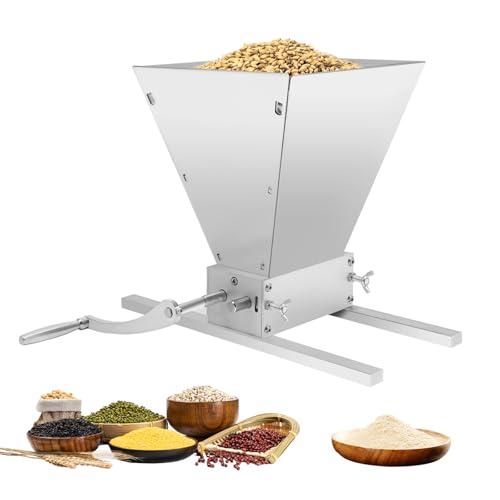
The GQWQNIO model provides fully adjustable rollers within 0–2.5 mm for precise grind control, suitable for beer brewing or baking. It uses carbon steel rollers and a stainless steel housing for durability and ease of cleaning. It supports manual operation or electric drill attachment for faster milling, making it versatile for both small and larger batches. The 4-liter capacity in the hopper keeps you in motion during mashing.
Best for: brewers who want fine control and dual-power options in a compact setup. Limitation: not all users will need the full 2.5 mm range. Choose this if you want a highly adjustable, two-power-setup mill.
Buying Guide: How to Choose Your Home Brewing Grain Mill
- Grinding method: Manual mills are simple and quiet, ideal for small to medium batches. Electric-drill-enabled models offer higher throughput for larger batches but require power access.
- Roller design: Two-roller mills with adjustable gaps (0.025″–0.1″ or 0–2.5 mm) provide consistent crush and hull integrity. Larger gap ranges yield coarser grinds, while smaller gaps extract more fermentable sugars.
- Hopper capacity: A larger hopper reduces refilling during long mashing. 7.7 lb to 15 lb capacities suit bigger brews; 1.06 gal is adequate for smaller batches.
- Build materials: Stainless steel rollers and housing resist corrosion and are easier to clean. Aluminum hoppers save weight but require care to prevent residue buildup.
- Drill compatibility: If you plan to use a power drill, confirm a compatible drive shaft or hex socket and ensure slow-speed operation to protect grain husks.
- Grain compatibility: Most mills are optimized for malt, barley, and grains intended for beer. Avoid using corn or non-grain items unless specified by the manufacturer.
- Maintenance: Look for smooth rollers, easy adjustment knobs, and simple disassembly for cleaning to prevent husk clogging and stuck grains.
Frequently Asked Questions
- What grind size should I use for mashing? Start around a medium grind, then adjust the gap to finer or coarser based on mash efficiency and lautering pace. Aiming for a consistent crush without powder helps maintain a good filter bed.
- Is a drill-mode essential? Not for every brewer, but it helps when brewing larger batches. Use a low-speed setting to avoid overheating grains and preserving husk integrity.
- Can I mill corn with these mills? Most models in this list are not intended for corn, soybeans, or sugarcane. Check manufacturer notes before attempting.
- Which mill is best for beginners? A manual mill with a straightforward adjustment and moderate hopper, such as the VEVOR or Brewland models, offers a gentle learning curve and reliable performance.
- How important is hopper size? A larger hopper reduces refilling interruptions during long mashes, improving overall workflow for big batches.
- Can I use these mills for other grains? Yes, many systems crush barley and wheat well. Some models explicitly exclude certain grains; verify the product notes to avoid damage.
Leave a Reply