Best Grain Mill for Homebrew: Top Picks for 2026
For craft beer enthusiasts, a reliable grain mill is essential to control malt texture and mash efficiency. The following selections are among the best for homebrewers, offering durable steel construction, adjustable roller gaps, and variable grinding modes. Each option supports high-capacity batches and works with malted barley and wheat. This guide highlights five top picks with practical features and user-friendly designs to help you choose the right mill for your setup.
Summary Table of Selected Products
| Product | Brand | Hopper Capacity | Rollers | Key Feature |
|---|---|---|---|---|
| FERRODAY Malted Grain Mill – 2 Roller | Ferroday | 7.7 lb | 2 | Low-speed drill option for high throughput |
| Brewland Grain Mill Brewing for Grain Malt | Brewland | 7.7 lb | 2 | 8-calibration dial for precise crush |
| FERRODAY Malt Mill 2 Roller Stainless Steel Malt Crusher | Ferroday | 7.7 lb | 2 | Drill mode for high throughput |
| Brewland Grain Mill Pro with 3 Rollers | Brewland | 15 lb | 3 | Large hopper with dual grinding modes |
| Northern Brewer Hullwrecker 2-Roller Grain Mill | Northern Brewer | Standard 5–6 gallon bucket base | 2 | Fully adjustable gap, all-metal base |
FERRODAY Malted Grain Mill – 2 Roller

The Ferroday 2-roller malt mill is designed for homebrewers who want efficient milling with hull integrity preserved. It features a large 7.7 lb hopper, 5-inch rollers with 12 TPI knurling, and an adjustable gap from 0.025 to 0.1 inch. The mill is suitable for malted barley and malted wheat, and can be paired with a low-speed drill for faster throughput. Note that it is not recommended for corn, soybeans, flakes, or flour. Drill mode enables up to 7 pounds per minute in some setups, reducing manual effort during large-batch brews.
Brewland Grain Mill Brewing for Grain Malt
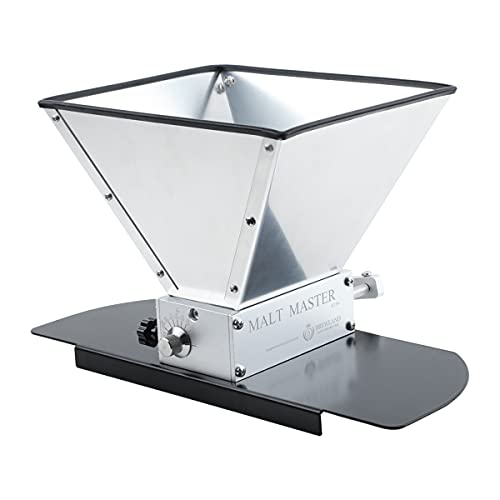
The Brewland grain mill is purpose-built for homebrewing, featuring an 8-calibration knob to adjust roller spacing from 0.025 to 0.1 inch. This helps release malted sugars without crushing husks, preserving sparge quality. It offers two grinding modes: manual crank or electric drill attachment via an 8mm hex socket. A 7.7 lb hopper supports sizable batches, boosting efficiency for larger brews. It’s designed for malted barley and malt, and excludes corn, coffee beans, soybeans, or sugarcane from milling.
FERRODAY Malt Mill 2 Roller Stainless Steel

This Ferroday model emphasizes a stainless steel build with a 7.7 lb hopper and adjustable roller clearance from 0.025 to 0.1 inch. Its design mirrors the popular malt-milling approach for brewing, ensuring hull integrity and a good sparge bed. A drill mode is available with a 3/8 inch shaft for high-throughput mashing. The crusher is intended for malted barley and malted wheat and is not suitable for corn or similar hard grains.
Brewland Grain Mill Pro with 3 Rollers

The Brewland Pro model upgrades to three rollers and a 15 lb hopper for large-batch brewing. It preserves malt sugars with an 8-calibration knob spanning 0.025 to 0.1 inch and offers two grinding modes (manual crank and electric drill attachment). The larger hopper improves work efficiency by reducing refills and helping maintain a steady workflow during longer brew sessions. As with other grain mills, it is not designed for corns, coffee beans, soybeans, or sugarcane.
Northern Brewer Hullwrecker 2-Roller
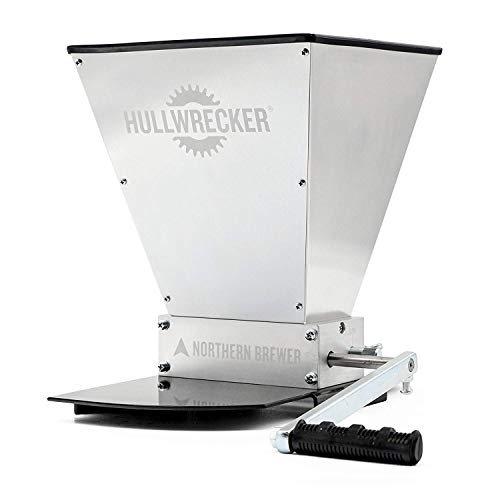
The Hullwrecker 2-Roller Grain Mill by Northern Brewer emphasizes dependable performance and ease of use. It features fully adjustable roller gaps from 0.025” to 0.1” for precise crush, with an all-metal base designed to fit standard 5 or 6.5 gallon buckets. This model is known for consistent milling results and sturdy construction, making it a staple option for traditional all-grain brewers seeking reliable, repeatable crush quality.
Buying Guide: Key Purchase Considerations
When selecting a grain mill for homebrewing, consider these factors to match your setup and goals:
- Grain compatibility: Most homebrewing mills are optimized for malted barley and wheat. Avoid models explicitly labeled for corn or other hard grains if your workflow centers on malt.
- Hopper capacity: A larger hopper reduces refilling during big batches. Choose 7–15 lb capacity if you regularly brew 5–10 gallon batches.
- Roller configuration: Two-roller mills are common and effective. Three-roller designs offer finer control but cost more and may be unnecessary for beginner to intermediate brewers.
- Calibrated gap control: An adjustable gap (often 0.025–0.1 inch) helps balance starch extraction and husk integrity for efficient sparging.
- Manual vs. drill-assisted grinding: Manual mills are quiet and affordable; drill-assisted mills increase throughput for large batches but require safe operation and a compatible drill.
- Build quality and materials: Stainless steel rollers and robust bases reduce wear and corrosion. A sturdy base helps maintain alignment during operation.
- Maintenance: Look for simple disassembly for cleaning and durability against grain residues that can affect performance.
- Ease of use: Consider whether you prefer a crank handle, electric drill compatibility, or both for flexibility in different brew days.
All five highlighted mills offer solid performance for homebrewers seeking reliable milling with adjustable settings. Your choice should align with batch size, preferred grinding mode, and how much you value a larger hopper versus a compact footprint. For frequent, high-volume brews, models with higher hopper capacity and drill compatibility may deliver the most consistency and efficiency. For occasional or space-limited setups, a compact, manually operated mill with a precise gap dial can be ideal.
Leave a Reply