Best Grain Mill for Brewing: Top Picks for Fresh Malt and Grain
Brewing quality beer starts with quality grain prep. A dedicated grain mill lets homebrewers crack malt, barley, and other grains to the exact consistency needed for efficient mashing and robust flavors. The following picks emphasize durability, grind control, and brewer-friendly features, helping you optimize mash efficiency and consistency.
style=”display:none;”>Summary Of Selected Products
- Brewland Grain Mill: Precise 0.025–0.1 inch roller spacing; 7.7 lb hopper; drill-ready option.
- Ferroday Malt Mill (2 Roller): Large 7.7 lb hopper; adjustable 0.025–0.1 inch gap; drill mode available.
- FERRODAY Malted Grain Mill: Similar high-capacity hopper; adjustable fineness; drill-ready.
- Victoria Manual Cast Iron Grain Mill: Classic hand-crank with adjustable coarseness; clamp-on design.
WonderMill Electric Grain Mill (Powerful): High torque, high throughput; lifetime warranty.
Product at a Glance
- Brewland Grain Mill — 7.7 lb hopper; 8 calibration knob for precise malt crushing; electric drill option.
- Ferroday Malt Mill 2 Roller — 7.7 lb hopper; adjustable gap; drill mode; suitable for malted grains.
- FERRODAY Malted Grain Mill — 7.7 lb hopper; adjustable gap; drill mode; malt-focused.
- Victoria Manual Cast Iron Grain Mill — Cast iron build; hand crank; adjustable grind; clamp-on.
- WonderMill Powerful Electric Grain Mill — 1,250-watt motor; high output; durable build with lifetime warranty.
Product Sections
Brewland Grain Mill For Homebrewing
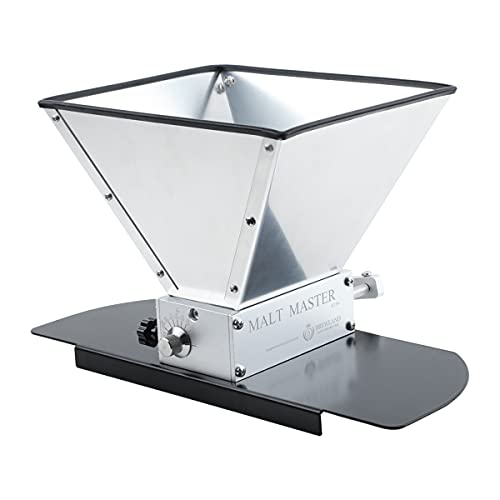
The Brewland grain mill is designed with homebrewers in mind. It offers an 8-calibration knob to adjust roller spacing from 0.025 to 0.1 inch, enabling precise malt extraction without damaging husks. It explicitly notes it cannot crush corn, coffee beans, soybeans, or sugarcane, and cannot mill grains into powder. A large 7.7 lb hopper supports batch grinding, and the unit can be driven by a low-speed drill for easier large-batch milling. This setup supports controlled mash efficiency and clean sparging by preserving grain husks.
Key features include:
- 8 calibration knob for precise roller spacing
- 7.7 lb hopper capacity
- Manual crank plus optional drill attachment
FERRODAY Malt Mill 2 Roller

The FERRODAY Malt Mill 2 Roller focuses on homebrew efficiency. It features a large 7.7 lb hopper and adjustable gap to produce malt crush fineness from 0.025 to 0.1 inch. The knurled rollers efficiently pull grains through while maintaining hull integrity for sparging. A strong drill mode enables higher throughput with a low-speed drill, making it well-suited for larger batches or repeated brews.
Highlights:
- 7.7 lb hopper capacity
- Adjustable gap for precise mash yield
- Drill mode for added power
FERRODAY Malted Grain Mill

This FERRODAY model targets malted grains for brewing with a robust 7.7 lb hopper and adjustable 0.025–0.1 inch gap. Like other FERRODAY mills, it includes powerful knurls and a drill-ready option, allowing brewers to scale up batches without fatigue. It’s designed to crush malt for beer brewing while preserving hulls for sparging efficiency.
Key aspects:
- Large hopper for high-volume mashes
- Adjustable roller gap for mash control
- Drill compatibility for higher throughput
Victoria Manual Cast Iron Grain Mill

The Victoria manual grain mill uses a cast iron design with a hand crank and a wooden handle. It offers a durable, clamp-on setup suitable for various table thicknesses (1/2″–2″). The unit emphasizes adjustability to control coarseness and fineness, making it a reliable option for brewers seeking a traditional, low-maintenance mill without electricity.
Notes:
- Cast iron construction with durable discs
- Manual operation with adjustable grinding
- Clamp-on design for versatile mounting
KitchenAid KGM All Metal Grain Mill Attachment

The KitchenAid KGM attachment extends a stand mixer’s capabilities to grind grains from coarse to fine. It’s designed to grind low-moisture grains such as wheat, corn, and rice, and includes a cleaning brush. It fits all KitchenAid stand mixers, offering a familiar user experience for brewers who already own a compatible mixer and want a compact, stationary milling option.
Considerations:
- Requires a KitchenAid stand mixer
- Grinds from coarse to fine with a single attachment
- Designed for low-moisture grains
Buying Guide: Key Purchase Considerations And Comparisons
What to look for when selecting a grain mill for brewing:
- Hopper capacity: Larger hoppers reduce refilling during long mashes; 7–8 lbs is common for brewing-scale batches.
- Roller design and gap adjustment: Two-roller mills with precise gap settings (0.025–0.1 inch) help achieve desired crush and mash efficiency. Ensure hull integrity is preserved for sparging.
- Drill compatibility: A drill-ready option speeds up milling for larger batches. If you primarily brew small batches, manual or handheld options may suffice.
- Material and build: Food-grade stainless steel or durable cast iron ensure longevity and safety in brewery environments. Avoid blades that degrade quickly.
- Power source: Electric mills offer speed and consistency; manual mills provide simplicity and quiet operation in small spaces.
- Grain suitability: Some mills are optimized for malted grains, others for general grains. Check that the model supports malt and barley crushing without powdering hulls excessively.
- Maintenance: Easy cleaning and simple disassembly reduce cross-contamination between grains and improve longevity.
- Compatibility: If you already own a stand mixer or drill, factor in compatibility with attachments and mounting options.
Brewing goals and workflow considerations:
- Batch size: Choose a hopper size and throughput that match your typical brew day to minimize downtime.
- Crush consistency: A consistent crush improves mash efficiency and repeatability across brews.
- Ease of use: A straightforward grinding process reduces labor and increases the likelihood of consistent results.
- Maintenance and safety: Look for mills with overload protection or safe shutdown features to protect the device and user during extended sessions.
Bottom line, for homebrewers prioritizing malt crushing, models with large hoppers, adjustable roller gaps, and drill-enabled capabilities tend to deliver the best balance of throughput, control, and durability. Manual mills offer reliability and simplicity, while electric mills provide rapid grinding for larger batches. Consider your typical batch size, available space, and whether you already own supporting equipment like a drill or mixer when making your selection.
Leave a Reply