Best Filtered Water Systems for Restaurants: Top Picks for Safe, Great-Tasting Water
If you’re seeking reliable filtered water systems for a restaurant, these five options cover under-sink, countertop, and commercial RO needs. They’re chosen for ease of installation, filtration performance, and suitability for high-demand environments. The best pick depends on your setup, water usage, and budget. The table below summarizes each recommended product and its ideal use case for quick comparison.
| Product | Best For | Filtration Type |
|---|---|---|
| ICEPURE Under Sink Water Filter System | Small to mid-size kitchens needing quick under-sink filtration | Multi-stage under-sink with 2,500 GPM flow potential |
| Frizzlife SK99 Under Sink | High-flow under-sink needs with easy DIY install | 8-layer 0.5 µm filtration |
| iSpring RCS5T Commercial Tankless RO | Low-waste, high-capacity RO for busy restaurants | 5-stage RO with 500 GPD membrane |
| iSpring CRO1000 Tankless RO | High-demand restaurants needing continuous purified water | 4-stage RO, 1000 GPD |
| Purewell 3-Stage 0.01µm Gravity System | Countertop option where gravity filtration fits workflow | 3-stage gravity UF with 0.01 µm |
ICEPURE Under Sink Water Filter System

Best for: small to mid-size restaurant kitchens needing a straightforward under-sink solution. This system offers a 2.5 GPM full flow rate at 60 PSI and a 22,000-gallon capacity. It’s NSF/ANSI 42 certified for chlorine removal and lead-free compliant under NSF/ANSI 372, supporting better-tasting, mineral-retaining water. The plug-and-play design helps reduce installation time and labor costs. A caution: ensure municipal supply pressure stays within the tested range to maintain performance.
Frizzlife SK99 Under Sink Water Filter System
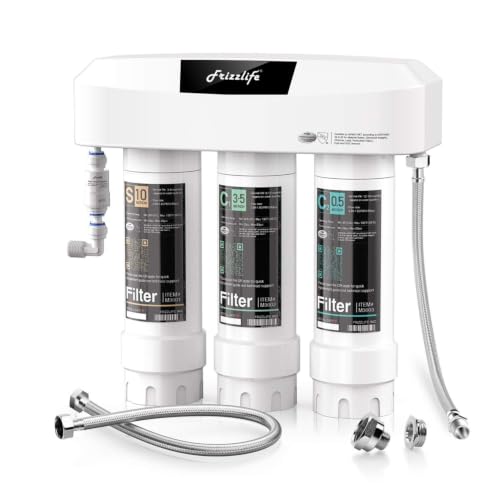
Best for: kitchens needing fast water flow and easy DIY installation. The SK99 uses eight filtration layers with 0.5 µm filtration to reduce lead, chlorine, taste, odor, and particulates while preserving beneficial minerals. It offers a fast cup-fill time and can serve both sink and refrigerator applications with compatible add-ons. Limitation: the manufacturer notes the system does not reduce total dissolved solids (TDS) as aggressively as some RO systems, so consider your water goals accordingly.
iSpring RCS5T Commercial Tankless RO Water Filter System
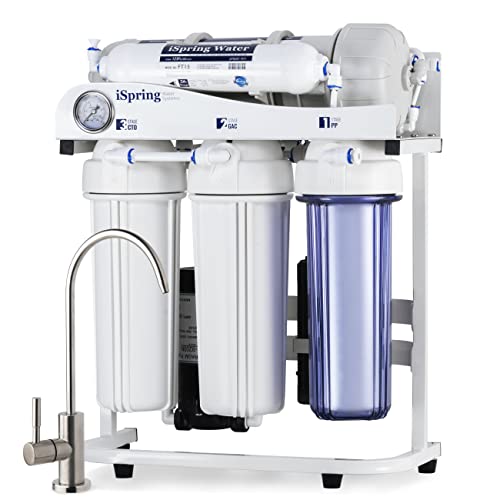
Best for: light commercial settings like restaurants needing reliable, on-demand RO water with high filtration. This 5-stage RO system targets PFAS, lead, chlorine, and other contaminants, with a built-in booster pump to handle lower water pressure. It emphasizes large-capacity filtration and durability, suitable for ongoing restaurant use. Limitation: the unit requires space for installation and regular maintenance to sustain optimal performance in a busy kitchen.
iSpring CRO1000 4-Stage Tankless RO

Best for: restaurants demanding high flow and superior filtration with a compact footprint. The CRO1000 provides up to 1,000 GPD with a 0.7 GPM continuous flow and a 4-stage filtration setup. It includes gauges for pressure monitoring and supports an optional booster pump for low-pressure situations. Consider: for very high throughput kitchens, confirm available space and professional installation feasibility.
Purewell 3-Stage 0.01µm Gravity System PW-OB

Best for: countertop setups where gravity filtration fits into the workflow and there’s space for a tall unit. This 3-stage system uses a 0.01 µm UF membrane with a stainless steel housing for durability and a water level window to monitor fill levels. It reduces chlorine and heavy metals while maintaining a steady flow of about 4 gallons per hour. Caution: gravity systems rely on consistent water pressure and head height to maintain flow rates.
Buying Guide: Key Purchase Considerations For Restaurant Filtration
- Filtration goals: Do you need taste improvement, chlorine removal, heavy metal reduction, or PFAS/lead mitigation? Match your choice to the primary contaminants in your supply.
- Water source and pressure: City water vs. well water affects unit size and booster pump needs. Tankless or gravity systems may require different pressure considerations.
- Flow rate and throughput: Restaurant usage can be high. Prioritize systems with higher GPM or GPD ratings to prevent bottlenecks during service.
- Installation footprint: Under-sink units save counter space but require cabinetry space. Countertop or compact tower models fit tight layouts.
- Maintenance and filter life: Consider cartridge or membrane replacement intervals, total cost of ownership, and standard filter availability.
- Certification and safety: Look for NSF/ANSI certifications (42, 53, 372) to ensure performance claims align with testing.
FAQ
- What type of water filtration is best for a restaurant?
– A combination of under-sink RO and gravity systems can balance taste, mineral retention, and throughput depending on tap usage and space. - How often should filters be replaced in a busy kitchen?
– Replacement intervals vary by system, contaminants, and usage; follow manufacturer guidelines and monitor water quality regularly. - Can these systems supply water to a soda fountain or ice machines?
– Yes, RO and high-flow filtration units can support ice machines and beverage stations when sized correctly for flow and pressure. - Are countertop gravity systems suitable for restaurants?
– They work well where space is limited or for secondary filtration but typically have lower throughput than RO systems. - Do these systems remove minerals from water?
– Some RO systems remove minerals; consider remineralization options if mineral content is important for taste or equipment.
Leave a Reply