Best Meat Slicer Options for Home Cooks and Food Enthusiasts
Answering your search for the best meat slicer, this guide showcases five top options that balance performance, ease of use, and value for the home kitchen. Each pick targets common buyer needs: straight-forward operation, adjustable slice thickness, easy cleaning, and durable blades. Whether you’re preparing deli meat, cheese, bread, or produce, these slicers fit different cooking styles—from weekly meal prep to entertaining guests. The quick-reference table below highlights the key strengths of each model to help you compare at a glance.
| Product | Best For | Key Benefit | Approx. Thickness Range |
|---|---|---|---|
| Borlebbi Meat Slicer | Everyday home cooks | Two blades for versatile slicing | 0–15 mm |
| VEVOR Commercial Meat Slicer | Home use with pro features | High power, wide blade, built-in sharpener | 0–12 mm |
| Weston Electric Deli Slicer | Small households seeking quiet operation | Low-noise, belt-driven | Delikatesk to over 12 mm |
| Elite Gourmet EMT-625B | Value-focused buyers | Removable blade, precise control | Razor-thin to 12.7 mm |
| CUSIMAX Electric Deli Slicer | Versatile prep and parties | Two blades (serrated and non-serrated) | 0–15 mm |
Borlebbi 200W Meat Slicer Review

The Borlebbi 200W meat slicer is designed for home kitchens that want reliable, straightforward slicing with minimal cleanup. It includes two stainless steel blades and a stainless steel tray to organize sliced pieces. The thickness control knob covers roughly 0–15 mm, suitable for meats, cheeses, and firm vegetables. The removable components—blade, carriage, slide-rod extension, and pusher—facilitate thorough sanitization. Best for daily meal prep and small gatherings where quick, even slices matter. Caution: ensure proper blade alignment during setup to maintain consistent cuts.
VEVOR 10-Inch Slicer With Sharpener

The VEVOR 10-inch slicer blends a powerful 240W motor with a wide blade and an integrated sharpening stone, enabling efficient processing of raw, cooked, and frozen meats, as well as cheese and deli items. It offers 0–12 mm (0–0.47 inches) thickness control for precise cuts. Best for home chefs who want near-commercial capability in a compact package. Limitation: higher power models can be louder and require careful maintenance of blade alignment for optimal results.
Weston Electric Deli Slicer For Home

Weston’s deli slicer emphasizes quiet operation and steady results with a belt-driven motor and adjustable thickness control. It’s well-suited for households that want deli-thin cuts consistently with minimal noise. Best for those who value a calm kitchen environment and straightforward operation. Caution: thinner slices over time may demand more blade maintenance to sustain edge sharpness.
Elite Gourmet EMT-625B Precision Slicer
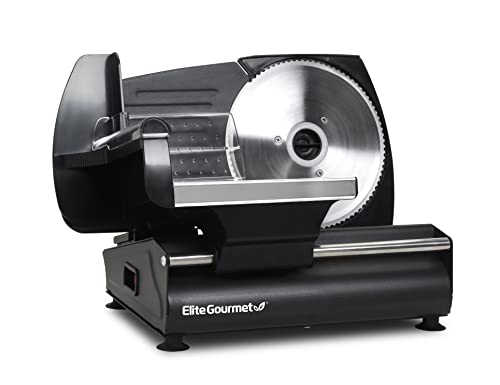
The Elite Gourmet EMT-625B focuses on precise, easy slicing with a removable stainless steel blade and adjustable thickness from razor-thin to about 12 mm. It’s positioned as a practical option for families and small offices that slice cold cuts, hard cheeses, bread, and vegetables. Best for users who want a compact, affordable slicer without extra frills. Limitation: some users may want extra blade options for specific textures or foods beyond standard deli items.
CUSIMAX Double Blade Electric Slicer

The CUSIMAX slicer includes two 7.5″ blades—one serrated and one non-serrated—plus a thickness range up to about 15 mm. The dual-blade setup supports a variety of foods, from meats to bread and fresh produce. Best for entertaining or meal-prep where you want flexibility without swapping blades. Caution: ensure you use the correct blade for the food type to avoid uneven slices or food sticking.
FOHERE 250W Multi-Use Slicer

The FOHERE 250W slicer is built for home kitchens that want versatility. It uses two upgraded blades (serrated and non-serrated) to handle meat, cheese, bread, and vegetables. Thickness can be adjusted from 0 to 15 mm, accommodating deli-style slices and thicker portions. Best for cooks who want a single tool for a wide range of foods. Limitation: larger foods might require hand-guiding for uniform slices, especially with denser meats.
Buying Guide
What to consider when choosing a meat slicer for home use:
- Power and speed: Higher wattage models slice more quickly and handle tougher textures. Look for 150–240W as a good home range.
- Blade size and type: Larger blades (8–10 inches) offer more versatility; consider serrated vs. non-serrated blades based on your food types.
- Thickness range: A wider 0–12 mm or 0–15 mm range covers deli-thin to thicker cuts for sandwiches and roasts.
- Ease of cleaning: Removable blades, carriages, and pusher components simplify sanitation and maintenance.
- Build quality and safety: Non-slip feet, blade guards, and a stable carriage help prevent accidents.
- Maintenance needs: Some slicers include built-in sharpeners; others require manual upkeep and blade alignment checks.
Practical Comparison Questions
- Should I buy a slicer with two blades? If you frequently switch between meat and cheese, a dual-blade design saves time.
- Is a belt-driven slicer quieter than gear-driven? Yes, belt-driven models typically run smoother and quieter, which helps in home kitchens.
- Do I need a professional-grade slicer for home use? For occasional home use, a compact 150–240W slicer with adjustable thickness is usually sufficient.
- How important is a built-in sharpener? A sharpener helps maintain edge quality, but not all models include one.
FAQ
- What is the typical thickness range on home meat slicers? Most models offer approximately 0–12 to 0–15 mm, suitable for deli meats and cheeses.
- Can a slicer handle frozen meat? Some models with higher power and sharp blades can slice semi-frozen meat more effectively; check the specification before attempting.
- Are removable parts dishwasher-safe? Many slicers advertise dishwasher-safe components, but always consult the product manual for proper cleaning.
- Is it necessary to have two blades? Dual blades are convenient for separating types of foods and avoiding cross-contamination when slicing raw and cooked items.
- What maintenance is required? Regular cleaning, blade alignment checks, and occasional lubrication (if recommended) help preserve performance.
- Which slicer is best for small households? Models with compact footprints, quiet operation, and good price points are ideal for small households.
Leave a Reply