Best Coffee Bean Roaster: Home Roasting Made Easy for Fresh Flavor
Roasting coffee beans at home unlocks peak flavor, aroma, and customization. This guide highlights top coffee bean roasters that balance ease of use with precise control, helping American homes achieve café-quality roasts. Each product below is evaluated for batch size, heat control, ease of cleaning, and smoke management to fit different kitchen needs and preferences.
Summary of Selected Products
- Fresh Roast SR540 Automatic Coffee Bean Roaster — 120 g batch, convection-assisted, 9 power levels
- Fresh Roast SR800 Coffee Roaster — 170–226 g batch, digital display, fast roasting
- NIASIA 500g Automatic Coffee Roaster — 500 g capacity, 9 profiles, smoke exhaust options
- LUEUR Electric Coffee Bean Roaster Machine — 100 g capacity, 1500W, adjustable timer
- Portable Glass Coffee Bean Roaster — 50–80 g small batch, transparent view
Fresh Roast SR540 Automatic Coffee Bean Roaster

The Fresh Roast SR540 provides a compact entry point for home roasters seeking consistent results with user-friendly controls. It roasts up to 120 grams per batch and emphasizes real-time temperature display and nine power settings for precise color development. Its convection-assisted approach aims for even heat distribution across smaller batches, making it suitable for experimenting with light to medium roasts. The unit is designed for quick roasts, often yielding flavors with more pronounced acidity and aroma fidelity than pre-packaged beans.
Key features include: a real-time temperature readout, nine adjustable power levels, and a speed roast system that supports rapid yet even roasting. The device is described as beginner-friendly while offering enough control for seasoned roasters to dial in a preferred profile. Roasting time for 7–14 cups in under 10 minutes positions it as a practical option for daily coffee routines or small gatherings.
Fresh Roast SR800 Coffee Roaster

The SR800 is a step up in batch size and capability, handling 170–226 grams per batch and offering nine power levels along with a digital display. This model is built for faster roasts without sacrificing uniformity, leveraging a fluid motion system to distribute heat quickly and evenly. It supports a broader range of bean types, including decaf and specialty varieties, and is well-suited for households that crave fresh coffee with less waiting time between roasts.
What to expect includes: a quick roast cycle under 10 minutes for larger batches, robust control through a digital status readout, and convection-assisted airflow to minimize scorching. It is designed for users who want more roast consistency while still keeping the process approachable for weekend roasters learning to dial in flavor profiles.
NIASIA 500g Automatic Coffee Roaster

This NIASIA model targets higher capacity with a 500-gram batch, improving productivity for households that brew multiple pots or entertain guests frequently. It includes nine roasting profiles suitable for light, medium, and dark roasts, as well as profiles for various processing methods. The design includes smoke exhaust options to help manage aromatic byproducts, which is important for keeping kitchen spaces comfortable during larger roasts.
Important considerations include: automatic roasting modes that simplify the process for beginners, a note that the 500 g capacity is best used for batch sizes between 350–400 g for even results, and the inclusion of smoke exhaust components to reduce indoor smoke. It is not intended for heavy commercial use, but it serves as a capable home roaster for enthusiasts who want to expand beyond small-batch roasting.
LUEUR Electric Coffee Bean Roaster
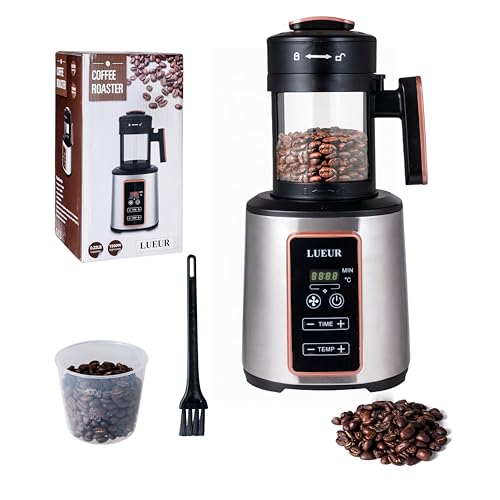
The LUEUR roaster emphasizes high power with 1500W hot-air circulation, designed for even roasting of up to 100 grams of beans per batch. Its adjustable timer and heat control allow roasters to experiment across light to dark profiles. A built-in chaff collection basket helps keep cleanup manageable, while the transparent, vented cover enables monitoring without compromising ventilation.
Key strengths include: efficient heat distribution through hot-air technology, straightforward controls suitable for beginners, and a compact footprint that fits standard kitchen counters. This model appeals to those who value a balance of control and simplicity, and who want to tweak roast levels without lengthy setup times.
Portable Glass Coffee Bean Roaster

This compact, stove-safe glass roaster uses high borosilicate glass, offering visibility and control for small-batch roasting of 50–80 grams. The transparent design lets roasters observe roast development in real time, helping to dial in precise roast levels. The glass construction also provides strong thermal stability for controlled heating directly over the flame or in ovens, making it a practical starter kit for hobbyists who want to see every stage of the roast.
Ideal for: introductory hobbyists who prefer hands-on observation, small kitchens with limited counter space, and hands-on learning about roast development. The small batch focus makes it less suited for frequent large batches but excellent for daily experimentation and education in coffee chemistry.
Buying Guide: Key Purchase Considerations
When choosing a coffee bean roaster, consumers should evaluate batch size, roast control, and ease of use. The following perspectives help balance needs across home use, budget, and flavor goals.
- Batch size and frequency — If you brew 1–2 pots daily, a 120–170 gram unit like the SR540 or SR800 may fit well. For households that entertain or need more throughput, the 500 g NIASIA model offers higher capacity, though it may require more space and cleanup effort.
- Roast control — Look for units with real-time temperature displays, adjustable heat or power levels, and multiple roasting profiles. Digital displays and convection fans help achieve consistent roasts and reproducible flavors, while simpler no-frills devices are better for beginners who want quick results.
- Ventilation and smoke management — Larger capacity roasters may produce more smoke, so consider models with built-in exhaust options or venting accessories to minimize indoor odors. For small apartments, devices with efficient airflow and easy cleaning are advantageous.
- Cleaning and maintenance — Roasters with removable drums, chaff collectors, and non-stick surfaces simplify cleanup. Transparent covers and accessible parts reduce maintenance time and encourage frequent roasting.
- Versatility — Some roasters support multiple bean types and processing methods, including organic or fair-trade varieties. Others focus on traditional green beans only. Consider whether you want to roast nuts or other foods occasionally, which some models accommodate.
- Durability and warranty — Home roasters experience heat stress over time. Look for models with robust construction and a reasonable warranty period to ensure longevity with regular use.
Flavor considerations also vary by technique. Lighter roasts tend to emphasize acidity and floral notes, while darker roasts yield body and roasted sweetness. Consistency across batches is essential for reliable flavor profiles, so a roaster with stable temperature control and even heat distribution is valuable for repeated results.
In sum, beginners typically benefit from compact units with clear displays and straightforward settings, while intermediate roasters may prefer higher capacities, expanded profiles, and better smoke management. For enthusiasts seeking peak performance, a larger model with programmable profiles and high-capacity batching can support more serious experimentation and multiple roasts per session.
Leave a Reply