Best Thermometer for Oven Calibration: Accurate Reads for Perfect Bakes
When calibrating an oven, choose a thermometer that delivers precise, stable readings at high heat. This guide highlights five reliable options suited to both home cooks and small kitchens, with clarity on who benefits most from each model. Whether you bake daily or grill on weekends, these thermometers help ensure your oven’s internal temperature matches the set dial for consistent results.
Summary table of selected products
| Product | Best For | Key Benefit | Range |
|---|---|---|---|
| Taylor Precision Large Dial | Home cooks who need large, easy-to-read dials | Bright, high-contrast dial for quick reads | 100–600°F |
| Rubbermaid Stainless Steel | Professional kitchens and home cooks | Wide range, durable, food-safety oriented | 60–580°F |
| PECULA Stainless Steel | Versatile placement; hanging or standing | Clear dual-zone indicators | 100–600°F |
| AcuRite 00620A2 | Leave-in use during cooking | Durable stainless steel with protective lens | 150–600°F |
| 2-Pack TempPro 431 | Cost-conscious households; multiple ovens | Bold dials; simple Fahrenheit/Celsius display | 100–600°F |
Taylor Precision Large Dial Thermometer, Silver

The Taylor thermometer features a large 3-1/4-inch dial, designed for quick visibility even from across a busy kitchen. It covers a wide temperature range from 100 to 600°F, making it suitable for most oven calibration tasks. A glass lens and red temperature pointer provide precise indication at a glance.
Best for: Home cooks who value readability and straightforward use. This model is especially helpful in kitchens where the oven is opened frequently and quick checks are needed. Caution: The large dial reads in Fahrenheit; users seeking Celsius-only readings may prefer a dual-scale option.
Rubbermaid Commercial Stainless Steel Monitoring Thermometer

This thermometer emphasizes food safety with a broad range from 60° to 580°F (20°–300°C). Built with stainless steel for durability, it’s designed to perform in professional kitchens and home setups alike, ensuring accurate oven readings during diverse cooking tasks.
Best for: Cooks needing a robust, wide-range thermometer that performs reliably under heavy use. Better for: environments where frequent calibration and quick cross-checks at lower temperatures matter. Limitation: It may be bulkier than some compact home models.
Stainless Steel Oven Thermometer 50-300°C/100-600°F (PECULA)
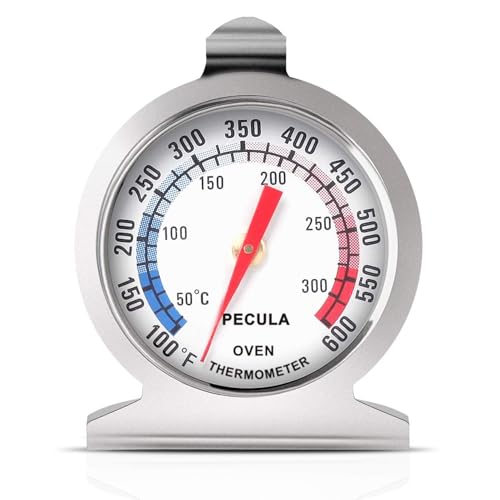
PECULA offers a versatile analog thermometer with a clear dual-zone dial, displaying both blue and red indicators for quick temperature checks. It features a hook and base plate for flexible placement—hang on racks or stand on a shelf. The battery-free design ensures dependable readings in high heat.
Best for: Those who want flexible installation and a clear, at-a-glance temperature read. Choose this if you frequently switch between hanging and standing placement. Limitation: The dial color zones are good for quick checks but may be less precise for nuanced calibrations than digital readouts.
AcuRite Stainless Steel Oven Thermometer (150°F to 600°F)

The AcuRite model provides a durable stainless steel body with a protective glass lens, designed for leave-in use during cooking. It reads from 150 to 600°F, aiding in precise temperature control for roasts, baking, and broiling tasks.
Best for: Kitchens that require a sturdy thermometer that stays in place during long cooks. Limitation: It begins at 150°F, so it may not be ideal for low-temperature checks below that threshold.
2-Pack TempPro 431 Oven Thermometer

TempPro’s 2-pack provides an economical option with a 100–600°F range and bold, high-contrast dials. The design includes a 3x3x1.61 inch footprint, making it suitable for inside gas ovens and pizza ovens where space is limited. It is described as battery-free and highly durable.
Best for: Budget-conscious households needing multiple probes for different ovens or grills. Choose this if you want a spare thermometer for backup calibration. Limitation: Some users may prefer larger dials for easier readings through oven doors.
Efeng Large Dial Oven Thermometer for Gas & Electric Ovens

Efeng’s model features a large 3.5-inch dial and a sturdy hanger-base combination that supports both standing and hanging placement. It reads 100–600°F, with NSF approval indicating suitability for professional or home kitchens concerned with safety and accuracy during long bake or roast sessions.
Best for: Those who want a highly legible dial with flexible mounting and NSF-aligned reliability. Limitation: The broad dial may be slightly less compact for very small ovens.
Youtex 2-Pack Oven Thermometer
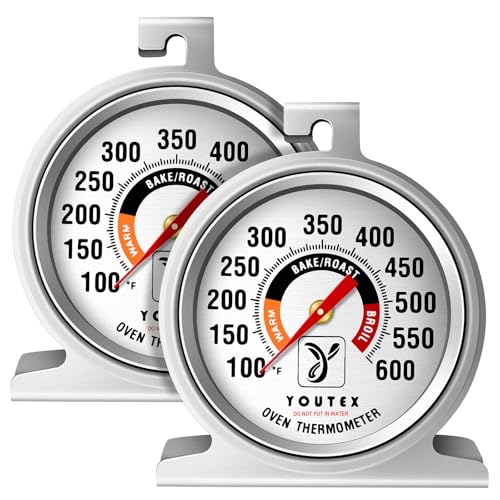
Youtex’s two-pack offers 100–600°F with a compact 2.5-inch dial and large, bright numbers. The no-holes stainless steel sealed design simplifies cleaning and reduces contamination risk, while dual-direction hooks and stands provide flexible placement.
Best for: Buyers who want compact, easily-cleanable thermometers and a simple setup. Limitation: The smaller dial size may be harder to read through certain oven doors compared with larger models.
Buying Guide: Practical Considerations For Oven Calibration
- Dial size and readability: Larger dials are easier to read at a glance, especially through oven doors. Consider your kitchen lighting and whether you prefer numbers in Fahrenheit, Celsius, or both.
- Temperature range: Most recipes require 100–600°F. Ensure the thermometer covers your typical bake, roast, and broil temperatures; some models start at higher minimums, which may limit use for low-temp tasks.
- Mounting flexibility: Hang-on racks or stand-alone bases increase placement options. If your oven shelf is tight, a compact model with a stand may fit better.
- Build and materials: Stainless steel bodies with glass lenses tend to endure high heat and frequent cleaning. Battery-free designs reduce maintenance needs and failure points.
- Readiness and accuracy: Analog dials provide immediate readings, while some users prefer digital options for exact numbers. For calibration, a consistent, repeatable reading is crucial.
- Cleaning and maintenance: Sealed no-holes designs reduce residue buildup. Wipe-down capability is essential for hygiene when monitoring roasts or meats.
- Intended use: If you frequently calibrate ovens in a professional or semi-professional setting, durability and long-term stability matter more than novelty features.
Frequently Asked Questions
- What temperature range should I look for in an oven thermometer?
- Are analog or digital oven thermometers better for calibration?
- Can I leave an oven thermometer in the oven during cooking?
- Is a larger dial always better for reading accuracy?
- Do I need a thermometer with dual temperature indications (Fahrenheit/Celsius)?
Most calibration tasks use 100–600°F. A thermometer that covers this full range is versatile for baking, roasting, and broiling.
Analog thermometers give immediate readings without batteries and work well for quick checks. Digital models can offer precise numbers but may require batteries or charging.
Yes, many thermometer designs are safe for leave-in use. Check the product specifications to confirm suitability for continuous exposure during cooking.
A larger dial improves readability, but accuracy depends on how well the dial marks are calibrated and how clearly the pointer moves. Choose a size that fits your oven and reading distance.
Dual indications are convenient for cross-checks and for cooks who prefer one scale over the other. It can simplify learning and reduce conversion errors during busy cooking sessions.
Leave a Reply