Best Equipment to Brew Beer at Home: Kits and Gear for Beginners
Answering the common question, the best equipment to brew beer at home ranges from all-in-one kits to essential brewing tools. For beginners, start with a complete kit that includes fermentation and ingredients. For more control, add a dedicated hydrometer, a sturdy brew bag, or a larger-capacity kettle. This guide highlights five practical options, showing who they’re best for and what to watch out for. The table below summarizes top picks and their ideal use cases.
| Product | Best For | Key Benefit | Notable Limitation |
|---|---|---|---|
| Mr. Beer Craft Beer Making Kit 4 Gallon | Beginner home brewers | All-in-one kit, brews in 30 minutes | Smaller batch size |
| Craft A Brew American Pale Ale Kit (1 Gallon) | New brewers wanting flavor variety | Clear guide and simple starter kit | 1-gallon batch; limited capacity |
| VEVOR 8 Gal All-in-One | Serious hobbyists | Large capacity, precise temperature control | Requires setup and supervision |
| Craft A Brew Oktoberfest Ale Kit (1 Gallon) | Fans of traditional styles | Full-bodied, malty profile | 1-gallon batch |
| SOLIGT Triple Scale Hydrometer | DIY brewers needing precise measurements | Accurate readings for gravity and ABV | Requires setup and additional gear |
Mr. Beer Craft Beer Making Kit 4 Gallon

The Mr. Beer 4-gallon kit is designed for beginners who want a straightforward, all-in-one brewing experience. It includes fermentation equipment, supplies, and ingredients, so no extra gear is required beyond basic kitchen items and water. The kit emphasizes quick results, with batches ready for drinking in 3–4 weeks. Best for first-time brewers who value simplicity and a compact batch size. A potential limitation is the 4-gallon volume, which may not satisfy experienced brewers seeking larger batches.
Craft A Brew American Pale Ale Kit

This 1-gallon starter kit targets new brewers who want a crisp, hoppy pale ale with clear guidance. It emphasizes independence and learning, offering a guided path into the craft of brewing with an included Craft Brewing Guide. It’s best for beginners who want a domestic, approachable style and a straightforward learning curve. The main limitation is the small batch size, which may produce fewer bottles per batch compared with larger kits.
VEVOR Beer Brewing Equipment, 8 Gal Kit

The VEVOR 8-gallon electric system is designed for hobbyists who want more capacity and control. An integrated heating element and electronic panel enable precise temperature management during mashing and boiling. This setup is suitable for producing larger batches and experimenting with different beer styles. A consideration is complexity: it requires more setup and monitoring than basic kits, making it less ideal for absolute beginners.
Craft A Brew Oktoberfest Ale Kit

This 1-gallon Oktoberfest kit delivers a traditional, malty profile with a clean finish, ideal for fans of Bavarian-style lagers and ales. It’s best for hobbyists who want to craft a classic, full-bodied beer at home without committing to large batches. A limitation is the 1-gallon size, which may be too small for households seeking more servings or richer flavors from bigger brews.
SOLIGT Triple Scale Hydrometer
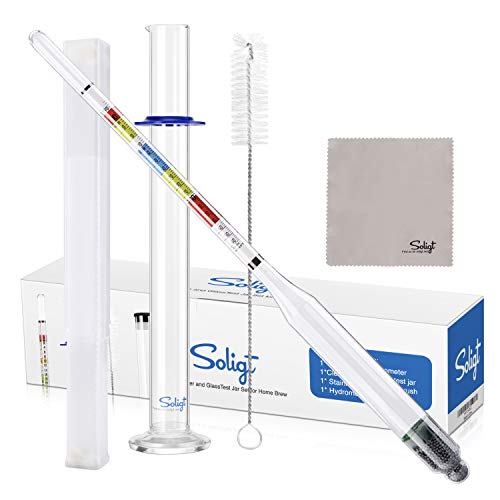
The SOLIGT hydrometer set includes a glass test jar and storage case, providing precise readings across specific gravity, Brix, and potential ABV. It’s best for brewers who want to track fermentation progress and refine recipes. The tool requires careful handling and calibration, and is not a standalone brewing system—only a measurement aid. Use it in conjunction with a reliable thermometer and a fermenter for best results.
Buying Guide
Starter vs. seasoned setup: Choose a starter kit for simplicity or a larger system for experimentation. If you want more control over flavors and batch size, consider a higher-capacity system such as the 8-gallon setup, but ensure you have space and comfort with the setup process.
What to consider when selecting home-brew equipment
- Batch size: Do you want 1 gallon, 4 gallons, or more? Larger batches produce more beer but require more space and time.
- Ease of use: All-in-one kits are quick to start; advanced systems offer precision but need more skill.
- Temperature control: Systems with programmable heating improve consistency for ales and lagers alike.
- Included gear: Some kits include fermenters, bottles, and ingredients; others require you to buy separately.
- Measurement tools: Hydrometers provide fermentation data; combine with a thermometer for best results.
How to choose by beer style
- Light to hoppy pale ales: Smaller kits with clear guides are sufficient for beginners.
- Traditional lagers and Oktoberfest styles: Larger capacity systems with careful temperature control help achieve clean finishes.
- Experimentation: A large brew kettle plus a hydrometer supports trying multiple recipes and tweaks.
Assembly and safety tips
- Clean and sanitize every component before use to prevent contamination.
- Follow kit instructions for exact timing, temperatures, and ingredient additions.
- Use a dedicated area for brewing to minimize spills and keep out of reach of children or pets.
FAQ
- What is the easiest way to start home brewing?
Use a complete all-in-one starter kit to minimize separate purchases and simplify steps. - Do I need special equipment beyond a fermentation bucket?
A hydrometer and thermometer help track fermentation and ensure consistency. - Is a larger kettle necessary for beginners?
Not required for single-gallon kits, but helpful if you plan bigger batches later. - How long does beer typically take from start to finish?
Most kits take about 3–4 weeks before drinking, depending on fermentation and conditioning times. - Can I brew different beer styles with one setup?
Yes, larger systems enable more variety, while smaller kits are best for quick experiments.
Leave a Reply