Best Olive Oil Acidity Test Kit for Quality Frying and Cooking
Answering the need for reliable acidity testing in olive oil storage and frying, these test kits help determine free fatty acid (FFA) levels quickly and with simple color or visual checks. They are best for professional kitchens, home cooks who fry often, and small food businesses seeking consistent results. The top five selections below cover visual, color-chart, and strip-based options to fit different workflows and budgets. A quick comparison table follows to highlight key features and suitability at a glance.
| Product | Best For | Testing Method | Approximate Range | Notes |
|---|---|---|---|---|
| FryTest Frying Oil Test Strips | Restaurants and large kitchens | Test strips with color chart | 0–6% (FFA) | Free app for HACCP journal |
| HYDRION Oil Quality Test Strips | Food service and cafes | Strips with color chart | 0–3% FFA | Simple, no device needed |
| Bartovation Frying Oil Test Strips (0–6% FFA) | Cost-conscious kitchens | Color blocks on strips | 0–6% FFA | Moisture-wicking cap bottle |
| Macherey-Nagel Oil Test Paper (Box of 100) | Lab-like checks in bulk | Oil test paper strips | Varies by kit | Paper-based, simple extraction |
| Bartovation Frying Oil Test Strips (0–8% FFA) | Higher-range monitoring | Color chart comparison | 0–8% FFA | Three-step process, quick results |
FryTest Frying Oil Test Strips
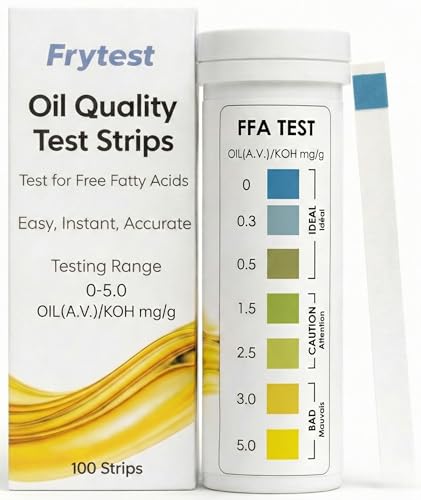
Best for high-volume kitchens needing quick checks with documented records. The kit measures free fatty acids (FFA) to indicate oil degradation and whether replacement is necessary under professional practice. It includes a free app to log and timestamp tests, supporting HACCP documentation in eight languages. No device is required; simply dip and compare to the printed color chart.
- Best for: Restaurants and catering operations that want an audit-ready log.
- Why selected: Combines simple chemistry with digital record-keeping for compliance.
- Caution: App availability may vary by region; ensure it suits your device ecosystem.
HYDRION Oil Quality Test Strips

Great for daily kitchen monitoring of fryer oil, especially in busy food-service environments. These strips measure 0 to 3% FFA, helping chefs maintain flavor consistency and prevent rancidity. The test is designed to be user-friendly with no additional devices required.
- Best for: Cafés, bistros, and casual dining operations.
- Why selected: Simple, reliable readings with straightforward interpretation.
- Caution: Narrow range may require more frequent checks in heavy fryers.
Bartovation Frying Oil Test Strips (0–6% FFA)

Best for kitchens seeking a broad FFA range with easy-to-read color blocks. The 0–6% scale supports routine checks to determine when oil should be replaced. Comes in a moisture-wicking cap bottle for easy storage.
- Best for: Budget-conscious operations needing repeatable results.
- Why selected: Cost-effective, clear color scale, reusable bottle design.
- Caution: May require practice to match color precisely in variable lighting.
Macherey-Nagel Oil Test Paper (Box of 100)

Best for bulk, lab-style practice in research or large-scale food production. The box contains 100 strips designed for testing oil, offering a straightforward paper-based method. Use as a supplementary check or in combination with strip tests for cross-verification.
- Best for: Research labs, kitchens with high testing throughput.
- Why selected: Bulk supply reduces per-test costs and supports methodical QA practices.
- Caution: Requires careful handling and interpretation in low-light environments.
Bartovation Frying Oil Test Strips (0–8% FFA)

Best for higher-range monitoring to extend oil life while ensuring safety and performance. The kit measures FFA from 0 to 8% and uses a simple three-step process: heat the oil, dip the strip, compare after a minute. It’s a cost-effective option for facilities needing broader detection ranges.
- Best for: High-usage fry setups needing flexible range.
- Why selected: Wide FFA range supports proactive oil management.
- Caution: Higher range may be less precise at the upper end; use as part of a broader QA plan.
Buying Guide: Olive Oil Acidity Test Kits
What should I test for?
Look for free fatty acids (FFA) as the primary indicator of oil degradation. A higher FFA suggests reduced quality, off-flavors, or rancidity risk. Choose a kit with a clear color chart or digital logging if HACCP documentation matters to your operation.
Which testing method fits my workflow?
Visual strip tests are fast and simple for busy kitchens. Paper-based options offer bulk value for labs or large facilities. If you need traceable records, select kits with an app or logbook integration to support compliance.
What range do I need?
Most culinary use falls within 0–6% FFA. If you monitor higher-heat or heavy-use fryers, consider a higher-range kit (0–8%) to avoid frequent replacements and to extend oil life.
How important is ease of use?
User-friendly designs reduce interpretation errors. Color charts should be easy to read under typical kitchen lighting. Kits with simple, device-free steps minimize training time for staff.
What about cost and waste?
Bulk options or bottles with moisture-wicking caps can lower per-test costs and reduce waste. However, always balance cost with accuracy and the need for consistent results in a commercial setting.
Maintenance and data handling
For HACCP compliance, choose kits that offer test logging, timestamping, and multilingual support if your operation spans regions. Ensure you can store and retrieve test data efficiently for audits.
FAQ
- Q: What does FFA tell me about olive oil quality?
- A: Free fatty acid level indicates oil degradation; higher FFA means oil should be replaced or filtered to maintain flavor and safety.
- Q: Do I need any equipment beyond the test strips?
- A: Most kits are device-free, using color charts, but some offer apps for logging results and HACCP documentation.
- Q: Is a higher range better?
- A: A higher range offers broader monitoring. Choose based on your typical fryer conditions and replacement frequency.
- Q: Can these kits be used for olive oil testing in home kitchens?
- A: Yes, many kits are suitable for home use, though professional-grade options are often designed for higher volume operations.
- Q: How often should I test frying oil?
- A: Testing frequency depends on usage, fryer temperature, and oil type. In high-use settings, daily checks are common; in home use, weekly checks may suffice.
Leave a Reply